
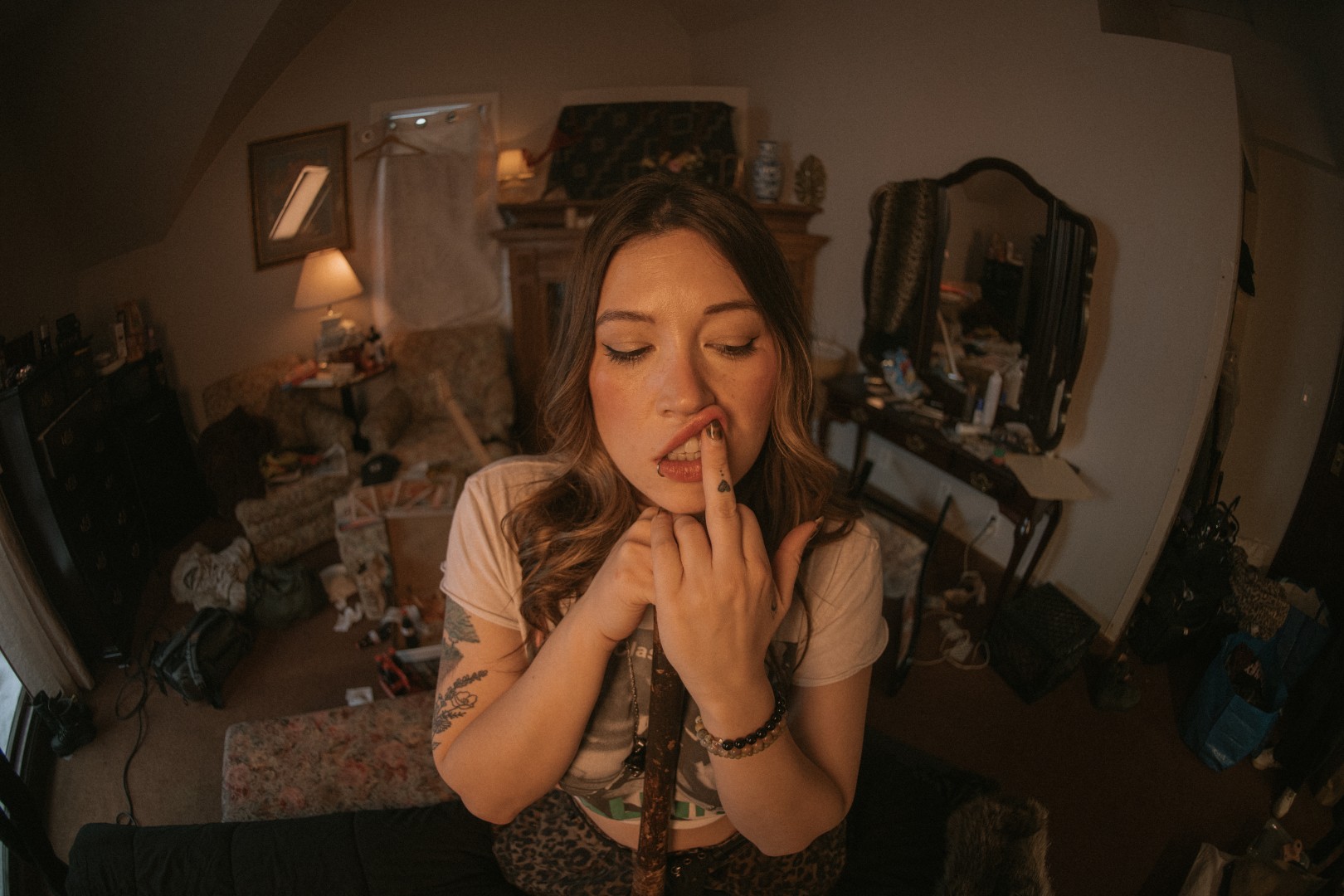
Thea May is ready to unleash her new EP on the world, and we do mean unleash. Living With It drops in just a couple of weeks, so we wanted to learn more about this inimitable artist, and take in what she knows we all need to know.
Thea May is a songwriter finding her purpose, or more accurately, understanding the purpose that found her. “My artist journey hurts sometimes, but it’s healing and it’s important that I am here to share this with the world,” says Thea. The Anishinaabe artist from Atikameksheng Anishnawbek, ON, is an emo kid at heart, and she has been making music since she was an actual kid. As a child, Thea’s singing, dancing and performing were driven by impulse, an inner force of truth that found its way out. Now, as an adult, Thea begins to channel that power, and she is determined to craft her own distinct eras, starting with Brought To You By Tragedy (March 2025). This was the EP that established Thea’s powerful, once in a generation voice. Rooted in Thea’s Anishinaabe identity and lived experience, her sound is driven by 90’s grunge guitars and fearless rock vocals.
Now Thea is back with Living With It (October 15th, Ishkōdé Records). This is her reckoning record: a bruised, unfiltered document of what it means to survive without softening the truth. Across these songs, Thea refuses consolation, rejects performative care, and pulls listeners straight into the emotional aftermath rather than offering tidy resolutions. It is a collection about staying alive inside discomfort, living in the wreckage of love, addiction-adjacent coping, inherited pain, and the quiet expectation to be “okay” for everyone else.
That idea of staying alive inside discomfort is central to Thea’s work, and she is direct about why it has become such a strong theme in her music.
“Staying alive inside discomfort; because all of this is a journey and an experience for our spirits/souls. I don’t know when the end of this physical cycle is for me, and I don’t get to know. I only get this vessel once, and she can rip a great vocal, write a banger and perform the shit out of it… and don’t forget, she will say what she means even if it hurts. I’m not saying being traumatized and oppressed is good for the plot, but I mean, I am traumatized and oppressed, and I have the tools to make something real out of that. Something I can give to people like me, who just needed someone else to say it. I bare my soul so you don’t have to, and that will always be my theme. Most of the songs I’ve written have hurt to write, and all that means is that I am blessed to feel.”
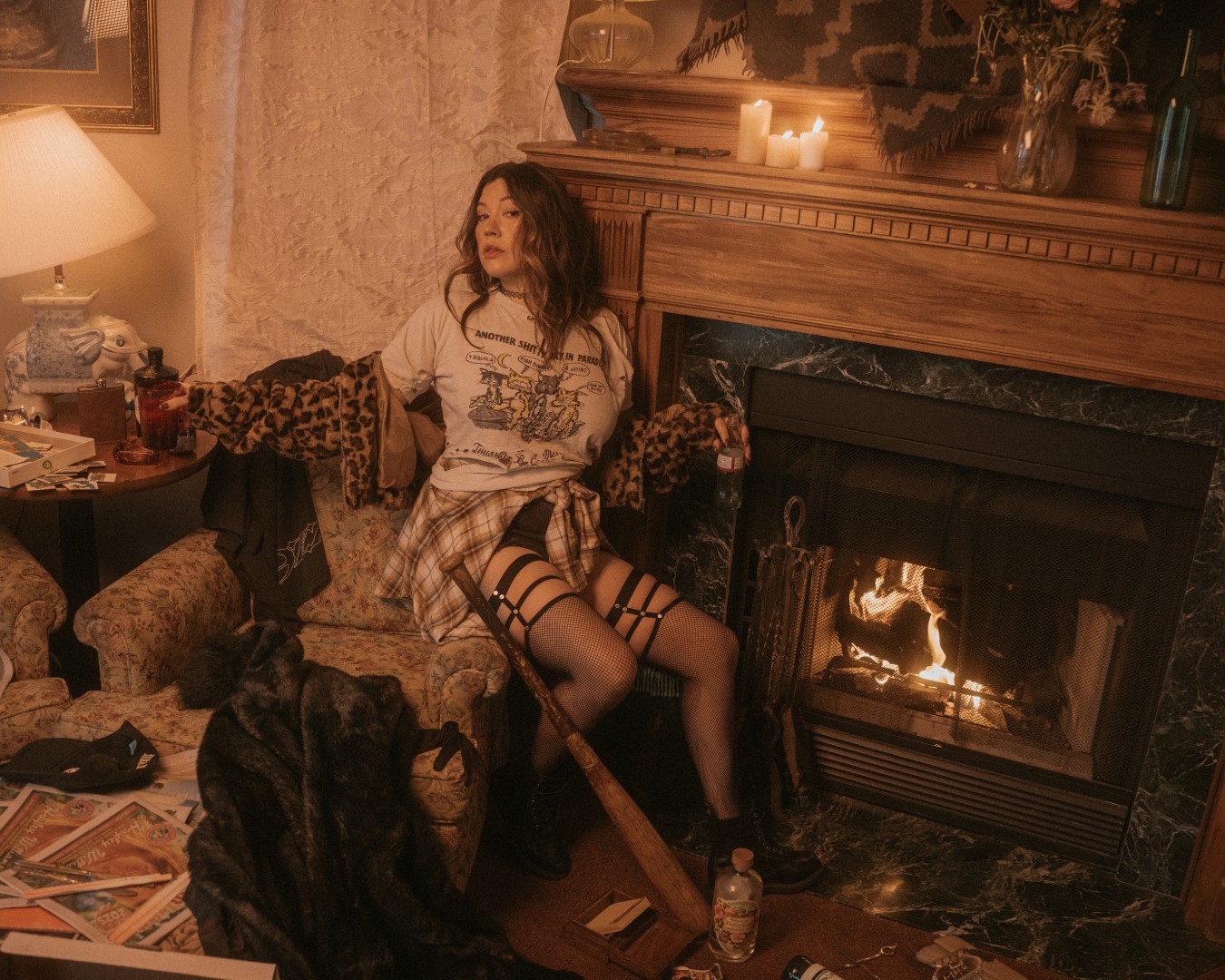
That sense of necessity runs through the entire creative process. Thea has said that she makes music because she has to, and she describes that responsibility as something she simply cannot escape.“I truly don’t think I could do anything else. It’s hard to explain the responsibility I feel having this talent and these opportunities. All the things that almost killed me became songs, so I guess at some point I figured I should probably keep doing something with that. If I’m carrying something when I’m writing, she’s gonna make an appearance. I don’t really get a say in it. Recording and performing have a similar effect on me, that’s the part where I get to let out whatever has been living inside me around the thing I just wrote about. I always feel like I meet a new version of myself after I write a song, then record it, then perform it. Like I’ve shed something, or at least moved it somewhere else.”
That musical catharsis is part of what connects Thea, her songs, and those who listen to her music. “Once it’s out in the world, it doesn’t really belong to me anymore. People get to absorb it however they need to. Maybe they hear something completely different than what I meant. Good. It’s theirs now. The music itself is the most human part for me. It makes that shit slap, bangers only, ear candy for days, but underneath all of that, this shit has to mean something. I don’t care how good it sounds if there’s nothing bleeding underneath it.”
That combination of emotional honesty and a refusal to take herself, or the expectations placed on her, too seriously comes through on the latest single, “Lip Service.” “’Lip Service’ is sarcastic,” Thea says, describing the track. “It’s got this 2000s skateboarding nostalgia thing happening, but lyrically it’s basically me being sick of the pity party. Growing up as a Native woman, I heard a lot of “poor Thea,” and it’s like… bro, it’s already bad, you actually make it worse when you say that. I don’t want to be defined by struggle. The struggle is there. It doesn’t need a fucking publicist. And I think there’s another side of it too, where people want to “help,” but they need everybody to see them helping. It’s very filming-yourself-helping-a-homeless-person energy. Like, make your donation quietly or stfu. Keep your pity. Nobody asked for it. So the song is kind of me making fun of all of that. It sounds fun, it feels nostalgic, you could probably skateboard to it, meanwhile I’m basically telling you to stop feeling sorry for me.”
For Thea, there is no clean separation between her identity, her lived experience and the music she makes. Her Anishinaabe identity and her relationship with grief, survival and connection are inseparable from the ’90s grunge and rock influences that shape her sound. “I don’t really separate any of it. Being Anishinaabe isn’t something I put into the music, it’s just who I am, so obviously it’s going to bleed into everything I make. The grief, the humour, surviving shit you probably shouldn’t have had to survive, that’s all there whether I want it to be or not. And I think that’s probably why I’ve always loved grunge. It wasn’t trying to make pain beautiful or clean it up for anybody. It could be ugly and loud and uncomfortable and still mean something. Sometimes more because of that. I come from people who have survived a lot, and I’ve survived a lot myself. So I guess the Anishinaabe part is in what I’m carrying, and the ’90s rock part is how I learned to make noise with it. I don’t really know where one ends and the other starts. I don’t think it’s supposed to.”
That same philosophy of refusing to clean up difficult emotions runs through the EP, particularly in the forthcoming “Not Okay,” which Thea describes as the song that most accurately showcases her desire to bare her soul so others don’t have to. “I would say the one coming next, “Not Okay,” probably encapsulates that the most. I often hear, “When are you going to stop writing about grief?” and it’s like… uhh, when people stop dying (lol). But really, “Not Okay” is probably the first song where I wrote really vulnerably about me inside of grief. The reality of being someone who can wear a smile, make jokes, show up, do all the things you’re supposed to do, while the pain still very much exists underneath it. Being okay and not okay can exist at the same time. I think people forget that.It’s very emo-coded. It doesn’t really try to resolve anything or give you some inspirational ending. Sometimes you’re just not okay and you still have shit to do.”
If Living With It is about refusing to pretend that everything is okay, it is also about recognizing that survival itself does not always look graceful, inspirational or resolved. Thea hopes listeners can find something of themselves in that reality. “I hope their crash out went well. I hope the highway was clear and their throats hurt from screaming so loud. I hope they feel a little more comfortable being happy and sad at the same time. I don’t think the darkness has to follow you everywhere just because it happened to you, but I also don’t think you have to pretend it never existed. You can acknowledge it, sit with it when you need to, and then put that shit down sometimes and rock out about it. I hope people feel proud of the moments they barely made it through. Even the ugly ones. Even the ones where you weren’t graceful or inspiring or particularly good at surviving — you just fucking survived.
Because same.
I think that’s what Living With It means to me. It’s not getting over it. It’s realizing you can carry something without letting it carry you.”
Thea Thea makes music because she has to, and the least we can do is listen. Living With It, will be out October 15 via Ishkōdé Records.
Keep up with Thea May via her website and social media below.
https://www.instagram.com/theamaymusic/
Nadia Elkharadly
Latest posts by Nadia Elkharadly (see all)
- Living With It – a new album and a conversation with Thea May - September 23, 2026
- ONDA PRO comes to Ontario – The latest in body contouring technology - September 15, 2026