
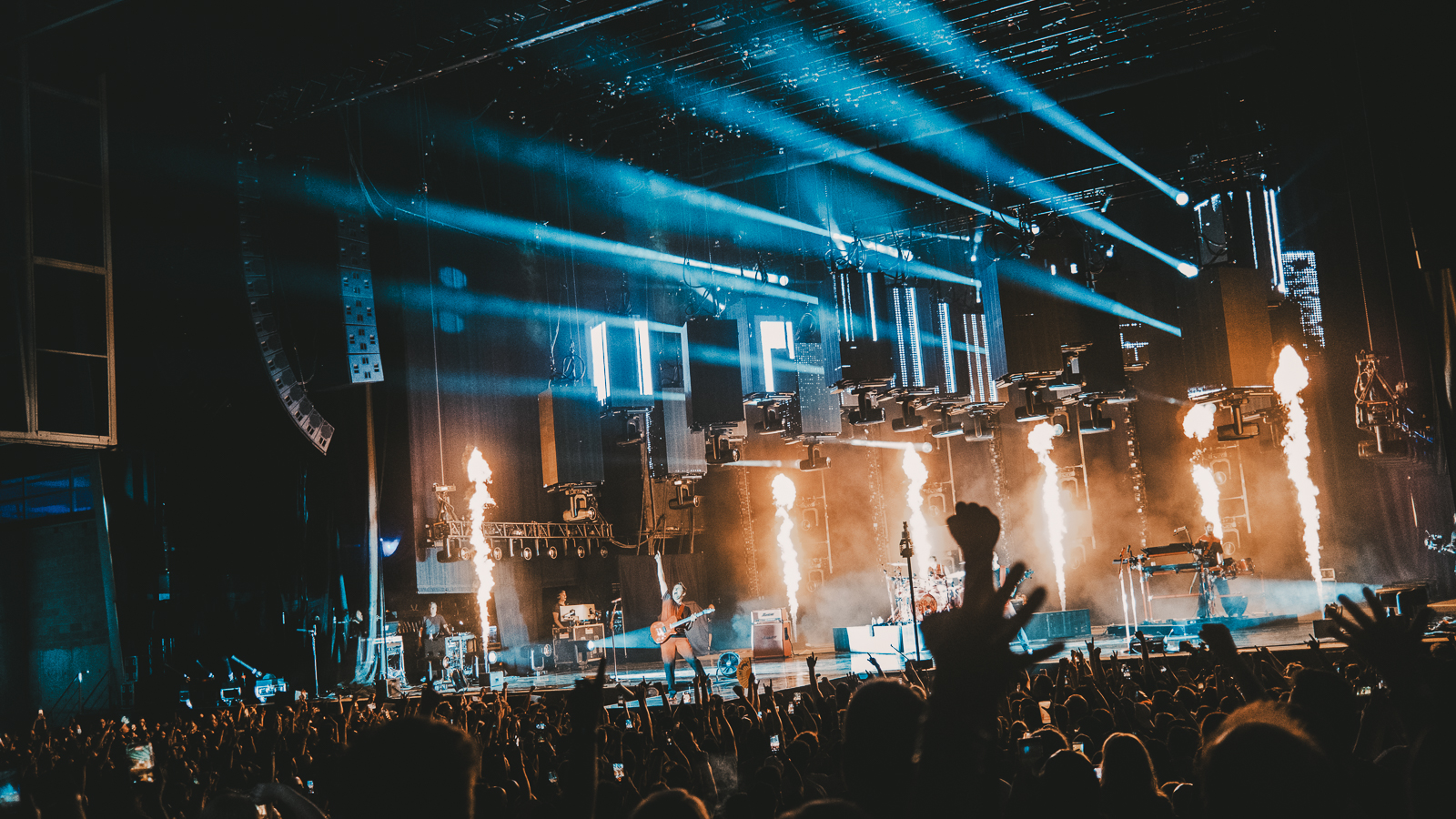
Muse’s return to Toronto on July 15 came just weeks after releasing their tenth studio album, The Wow! Signal, marking the RBC Amphitheatre show as another chapter in one of rock’s most consistently spectacular live legacies. In the months leading up to the album, the band gradually teased songs like Be With You, Cryogen, Hexagons, and Nightshift Superstar, before finally releasing the full record on June 26 and launching the accompanying North American tour. With this downtown performance, the juggernaut trio continued to demonstrate why they remain one of the world’s top-tier arena acts, blending elaborate and awe-inspiring visuals with a setlist that balanced career-defining hits and the newer material. Fans weren’t about missing any of it too despite Environment Canada issuing an orange air quality warning for Toronto. Perhaps seeing these legends were worth inhaling a bit of wildfire smoke.


Before tuning into the Wow! Signal, the evening began with The Temper Trap, who brought a warm, atmospheric indie-rock sound to RBC Amphitheatre. Frontman Dougy Mandagi immediately spoke to crowd with gratefulness for being part of the tour and proudly introducing themselves as a band from Australia. Their compact five-song set moved between older favourites and newer material, with Love Lost and Sweet Disposition providing the strongest connection to the band’s established catalogue, while Lucky Dimes, Into the Wild, and Giving Up Air represented their newer Sungazer era. Their 25-minute appearance felt quick yet jam-packed, setting a super expansive, melodic tone before the evening shifted toward something considerably more energetic.

Bloc Party followed with a longer set that felt like a crash course in the band’s nearly two-decade history. The songs jumped from two of their most recognizable songs from 2005’s Silent Alarm, Banquet and Helicopter before running through Hunting for Witches and So He Begins to Lie, before bringing in newer material from Anatomy of a Brief Romance, including Coming On Strong and Love Bombs. Fans were definitely excited for the new album that comes out mid-September but of course, Banquet and Helicopter just shook the crowd in a way that you’d hope it did 20 years ago especially if you missed it. Either way, the inclusion of two songs from the forthcoming album gave the set a good sense of being both retrospective and forward-looking. Louise Bartle’s drums were particularly machine-tight and really shines through. It was also a fitting Canadian return for Bloc Party, who had last played Toronto as support for Paramore in 2023 and this time, they were back in the city supporting another major alternative-rock institution.
In a satisfying way, this opener pairing made for a particularly strong lead-in to Muse. The Temper Trap supplied the a great atmosphere, Bloc Party sparked that ripping indie-rock urgency, and then Muse would ultimately expand those foundations into full-scale rock extravaganza.


Even before the band appeared, the arena was already immersed in atmosphere as CHVRCHES’ Clearest Blue echoed through the venue before flowing seamlessly into Interlude and the unmistakable opening bassline of Hysteria. More than twenty years after its release on Absolution (2003), it remains one of Muse’s defining live songs and there are few better ways to announce your arrival than starting with one of your hardest hitters. Chris Wolstenholme’s iconic opening shred launched the show into overdrive before pivoting straight into the new era with Cryogen and an extended-intro version of Supermassive Black Hole. That seamless jump from Absolution to Black Holes and Revelations (2006) and then into The Wow! Signal demonstrated how naturally Muse’s newest songs fit alongside their classics. Thought Contagion bridged another era before Stockholm Syndrome, complete with its Micro Cuts outro, became one of the evening’s heaviest moments, and rightfully so. Longtime fans are more than happy to rank it high among the band’s most beloved live staples. The instrumental reinterpretation of Kill or Be Killed that followed cleverly gave Chris and Dominic Howard the spotlight, with Dom’s thunderous drumming carrying the piece while Matt Bellamy’s vocals remained on tape, turning it into a rare showcase of the band’s rhythm section.


The middle portion balanced spectacle with familiarity and shifted between aggression and melody with remarkable ease. Be With You continued highlighting The Wow! Signal, and wowed the crowd with a huge towering wave of red confetti that launched into the ceiling right before Matt’s satisfying guitar solo. Then 2006’s Drones’ (Drill Sergeant) introduction launched into Psycho with its crushing riff is just one of Muse’s clear modern crowd-pleasers. Madness, complete with the crowd sing-along and Matt fisheye cam, slowed the pace without sacrificing atmosphere. From there, Matt Bellamy reminded everyone why he remains one of rock’s premier frontmen during Plug In Baby, effortlessly navigating its blistering guitar work before transitioning into the orchestral Hanging in Victory Square from the 1984 audio drama soundtrack Matt had worked on with Ilan Eshkeri. Plug In Baby felt like a HUGE part of the set naturally with its instantly recognizable opening riff just proving time and time again that it’s just up there with the band’s most beloved songs more than two decades after Origin of Symmetry introduced it in 2001.


The closing run of Time Is Running Out, Uprising, and Knights of Cydonia felt almost untouchable and represented perhaps the strongest sequence of crowd favorites in the entire show. First off, Muse just seems to never run out of lyrics that are just perfect for the crowd to scream to and Toronto didn’t miss a beat on Time Is Running Out. Then Uprising is just arguably Muse’s defining anthem, and basically a rallying call while Knights of Cydonia delivered one final Ampitheatre-sized karaoke session, which includes Chris opening the song on harmonica with Ennio Morricone’s Man With a Harmonica theme that feels like an awesome tradition that continues to elevate the track’s cinematic and western-inspired finale.

Rather than ending there, Muse shifted gears once more. The 2nd Law: Isolated System remix created a cinematic reset turning the rock-fuelled crowd into a brief techno rave before giving way to brand-new track Nightshift Superstar, one of the standout songs from The Wow! Signal that had only recently made its live debut earlier that month and had Matt Bellamy rocking a light-up sunglasses and jacket that more than fit the mood of the song and upgraded the party vibe. Both tracks pointed toward Muse’s unpredictable and fun creative direction before an instrumental intro a la Algorithm via Matt’s custom piano contraption bridged the gap back into Simulation Theory just to segue into Undisclosed Desires. Complete with the band’s introductions, it flowed beautifully into Prelude and Starlight, giving fans one final emotional high before the encore. The two songs being played back-to-back really highlighted the cohesion between the two piano-based tracks though being released 6 years apart. It really speaks to the throughline in Muse’s catalogue and feels very celebrated in this set that they put together for this tour.

For the encore, Muse resisted the temptation to unload another run of greatest hits and instead chose the theatrical grandeur of Take a Bow. Originally opening Black Holes and Revelations in 2006, the song has long been one of the band’s most dramatic live pieces, slowly building from eerie synthesizers into a towering wall of sound before ending in complete sonic collapse. It was a fitting conclusion to a setlist that travelled nearly the band’s entire recording career: from Origin of Symmetry through Absolution, Black Holes and Revelations, The Resistance, Drones, Simulation Theory, Will of the People, and into the newest material. Muse has a deep discography and their unique songwriting is a huge reason for that. But rather than just leaning into the nostalgia tour of celebrating an album turning 20-something, the evening easily reaffirmed that Muse remain a band still looking forward, using their legendary catalogue not only for the pleasure of long-time fans, but also as the foundation for whatever ambitious chapter comes next for one of the defining rock acts of the 21st century.
Keep up with the latest on their Instagram and Website.
