
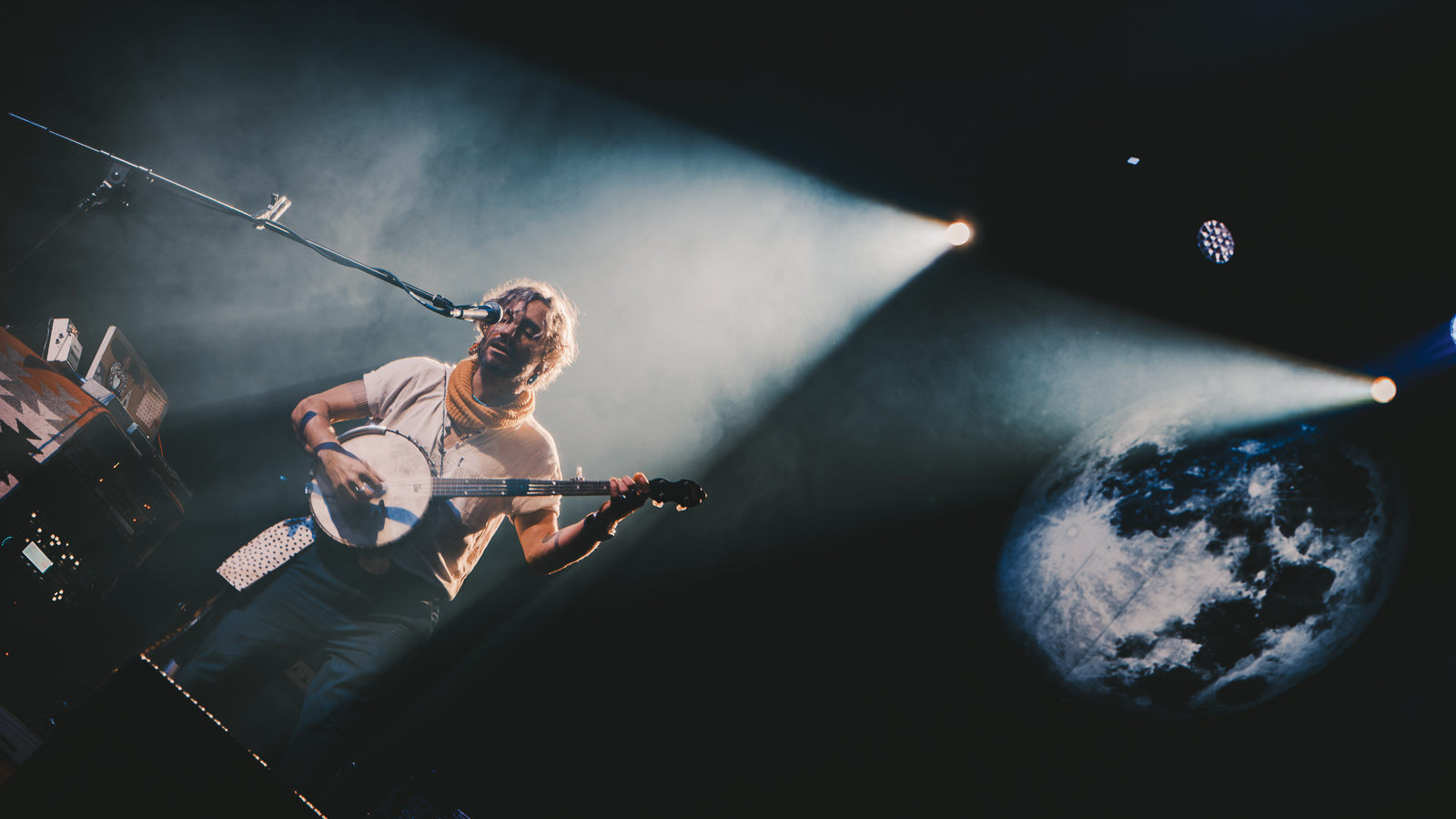
What immediately stood out about this show at History was that it was billed not as a stripped-down acoustic evening, but as John Butler With Band – a four-piece configuration that felt intentionally designed to reconnect the present with the spirit of the classic John Butler Trio years. This shouldn’t be foreign to diehard fans though with the lineup changing over the band’s lifetime based on musical direction. With an OG JBT drummer Michael Barker returning alongside Ian Peres on bass/keys and percussionist Michael Boase, the setup promised a full-band experience built around groove, improvisation, and catalogue-spanning material that’s something to be really excited about.


The setlist reflected that mission as immediately as the band took to the stage and with no fancy entrance at all, John began the show with a message of unity. And how being together and enjoying music is nothing new but is stuff of legend. It’s a great take that allows the audience to be present especially in a fast-paced digital world. With the crowd locked-in from there, Butler began with Going Solo and So Sorry, newer songs that established this current chapter before diving into the material that longtime fans had spent years waiting to hear with a full band again. It was a smart move: rather than leaning entirely on nostalgia, the show introduced itself in the present tense first.

Holstering his shiny acoustic guitar, John switched in the banjo to expected cheers from the crowd. Managing to squeeze in a quick Hoe Down, John also got to learn about “portaging” from the crowd and got to talk a bit about driving around Western Australia in his yute. From there, what might’ve been the first true eruption of the night came with Better Than. Originally released on 2007’s Grand National, it remains one of the most recognizable songs Butler has ever written and one of the tracks that arguably pushed the project beyond jam-band circles and into broader recognition. Hearing it arrive only a few songs in probably felt like a statement that yes, this would be a salute to the whole journey and it was like a whole new band rediscovering it.


That opening section also revealed one of the most interesting aspects of the set’s progression: the way it alternated between recent solo-era material and classic Trio songs. Betterman from 2004’s Sunrise Over Sea, and Revolution from 2010’s April Uprising, represented different eras of John Butler Trio entirely, while songs like Gets No Better that had History swaying, Outta My Head, and The Way Back reflected newer work. Instead of arranging the show chronologically, Butler built it emotionally. Kind of like a hike moving between familiar landmarks and newer terrain.
Midway through the set came one of the most anticipated moments in Wade in the Water. Live, this song has long functioned less like a standard performance and more like a showcase. It gives Butler room to stretch, improvise, and lean into the hypnotic guitar work that has made him one of the most respected live players of his generation. In a four-piece format, the song likely gained an entirely different dimension, allowing the groove section to expand underneath him. It just hits hard as hell especially with John’s skills sliding around across his guitar frets.


Then after slowing things down with Doing Just Fine, a carefree and feel-good PRISM track, came Ocean with John taking a seat and his guitar ready on his lap.
There are songs fans hope to hear, and then there are songs that feel almost mythical. Ocean sits firmly in the second category. Over the years the instrumental has become one of Butler’s defining works, not only because of its technicality but because of how much space it creates live. It has developed a near-legendary status among fans and has repeatedly gone viral online because of its complexity and emotional power. Its appearance here, under a single spotlight, almost certainly represented the emotional and musical centerpiece of the night and really makes it seem that John can make his guitar make whatever sounds he wants.
After a funny “thank you” interaction with a crowd member, another PRISM song made its way out. Leave The Rest To Earth felt like an inspirational journey a la Walter Mitty though John prefaced it jokingly with “this is a feel good number – it’s about death”. More crowd work brought out the reasoning why the show didn’t have openers as well: “we were finding to play a long ass time! 2 and a half hours is a lot!”


Now more than halfway through the show, the setlist shifted into deeper catalogue territory. Tahitian Blue brought things back to the early John Butler Trio years and brought History up to its feet dancing, while King of California (along with Leave the Rest to Earth earlier) leaned into Butler’s more reflective side. Once Used to Get High arrived though, the room probably shifted gears entirely. Clearly a crowd favourite in the entire catalogue, there’s a reason why it’s been a live staple thanks to its huge groove and communal energy – it’s easy to get into for sure.
The final stretch felt engineered for release. Treat Yo Mama remains one of the defining John Butler Trio songs and one of his most explosive live vehicles. His slide work here just sounds super satisfying. The extended jams and sheer force of that song alone could have served as a finale. Instead, Butler pushed onward into the keys-heavy Trippin On You, the last PRISM track of the set that got Toronto back to dancing, and Funky Tonight, carrying serious fan significance. Many longtime listeners associate it with some of the classic Trio-era live peaks, and fans continue to single it out as one of the songs they most hope to hear.
Then finally, the encore.

Peaches & Cream felt like a warm, celebratory return and it was easy to see based on the response of the Toronto crowd. People in the VIP section of History were lifting the fake candles at their tables as they yelled the words back. The lyrics “all I know is, all I know, and I love you” were sang by the audience alone to kick off this 2-song encore. John was impressed to hear a disappointed crowd when he announced the last song of the night: the inevitable closer, Zebra. After shouting out the band again, as well as all of the crew that made the entire night possible, there really could not have been another ending. Originally released on Grand National, Zebra remains a John Butler mainstream hit and one of the songs most closely associated with his rise. On top of some Freddie Mercury-esque vocal exercises with the audience beforehand, saving this song for the final moment gave the night that sense of completion and satisfaction. Ending with perhaps his most beloved anthem felt like the entire journey finally arriving home especially after spending more than two hours weaving through solo work, deep cuts, jams, and John Butler Trio staples.


Looking back, what made the set work so well was that it never felt like a reunion set or a greatest-hits package. It was just something new though still familiar and simply put by John, “the only reason why we don’t call it ‘trio’ anymore is because there are 4 of us” then a quick chuckle to cap the statement off. Nonetheless, it was more like a musical trek across eras – new songs standing beside old ones, solo work existing alongside Trio classics, and a full band serving as the bridge between all of it. Toronto was more than happy to follow along.
Keep up with the latest on their Instagram and Website.
