
A “clear” mammogram doesn’t always mean you’re truly clear
My first experience with breast cancer was when I was a child. I used to spend weekends with my grandmother, she made perfect soft-boiled eggs, always had some magical iced dessert waiting, and I’d fall asleep to the sound of Coronation Street humming in the background. At night, she would sneak into the bedroom to get ready for bed. She’d take off her bra and, in the shadows, I’d see her prosthetic breast. I didn’t understand what it meant. I remember wondering if that was what would happen to me one day. My mom explained that my grandmother had breast cancer, and that simple explanation planted a quiet fear I’ve carried with me ever since.
A few years later, my grandmother died, and that fear sank even deeper.
Pushing For Answers: The Self-Advocacy Journey
By 29, it nudged me to ask my family doctor for a mammogram. He told me I didn’t need one, as the risk of me getting breast cancer was low because of my paternal grandmother’s breast cancer diagnosis (it’s mostly passed down from the maternal side), but I pushed and, because I thought I felt a small lump, I was able to get checked. Years later, at 34, another mammogram led to an MRI. Everything came back negative, but the anxiety never really left. I kept testing. I told my girlfriends to test. I tried to live normally, but the possibility of breast cancer followed me like background noise.
Then the pandemic hit and my mom reminded me that once I turned 40, I could self-refer, but time slipped by as I waited for appointment delays to ease. I went to my doctor after feeling what I thought was a lump in my right breast and suddenly I was thrown back into that familiar world of uncertainty.
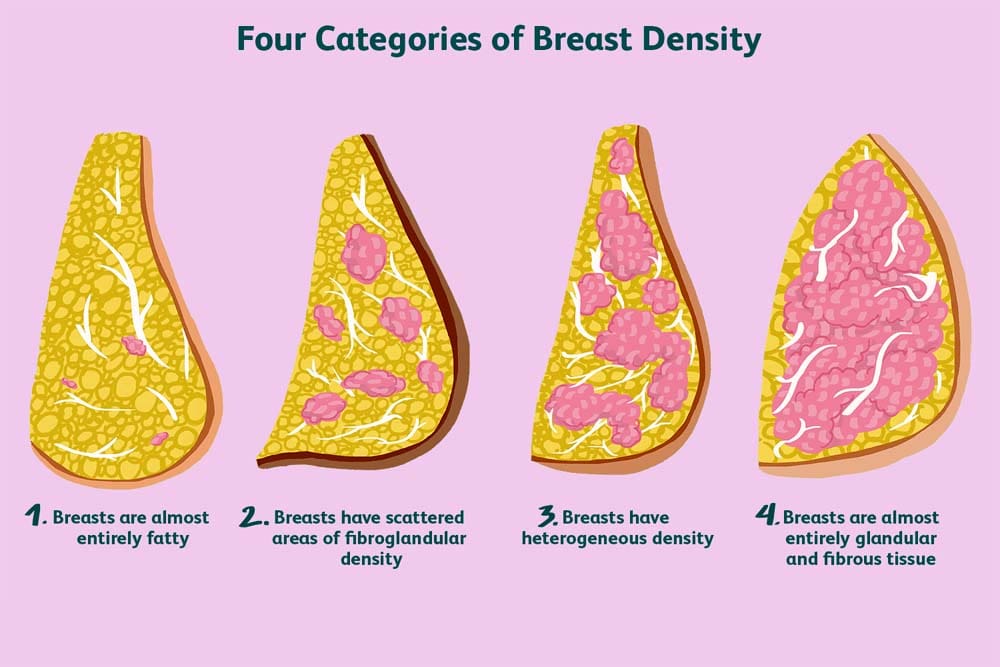
I was sent to a diagnostic clinic, two mammograms later, they told me I was cleared. But something still felt wrong. I learned I have dense breasts, level C (four levels total, D being the most dense), which makes cancer harder to detect. I knew I needed more clarity, so I called the CIBC St. Michael’s Breast Clinic and self-referred to the Ontario Breast Screening Program for an annual screening.
A month later, I had my appointment. Because I had recently tested the right breast, they could only scan the left that day. I thought, Fine. Both will be clear. This will be simple. It wasn’t simple.
Beyond the Mammogram
Over the next few months, I had four mammograms and one biopsy. The biopsy was benign, but difficult to perform because it was close to my breastbone. My oncologist suggested an MRI “just to be safe.” Waiting for that MRI was the longest stretch, pure limbo for months.
Then the result appeared in MyChart: the radiologist recommended a bilateral MRI-guided core biopsy due to calcifications in both breasts. I had never even heard of calcifications. I always assumed cancer meant a lump you could feel. But these were tiny clusters, things I never would have noticed, another reminder that a “clear” mammogram doesn’t always mean you’re actually clear, especially with dense breasts.
After two more biopsies (a second in the left breast and one in the right), my left breast was cleared. I tried to stop worrying about the right breast; as it had been cleared just months before. Then, during a press day for a client, new results appeared in MyChart: DCIS in situ, with a small area of invasive cancer in my right breast.
I went into shock. I was terrified. I googled everything: survival rates, treatment options. I convinced myself it would be a lumpectomy because the size looked small on paper. Friends and family tried to reassure me, sharing stories of minor breast cancer surgeries and good outcomes. I clung to that hope. I barely slept.
The Only Option
A few days later, with my parents by my side, my oncologist who was kind and emphatic, told me the truth: with my DCIS diagnosis, a mastectomy was the only real option if I wanted reconstruction options and hoped to avoid radiation. My cancer was stage zero within the ducts, so it was harder to tell its size, but because a small bit had begun to grow outside the ducts, it was considered stage one. My next steps were meeting a plastic surgeon and completing genetic testing to see whether I carried BRCA or other gene mutations that could impact treatment and future decisions.
I panicked again. Another test. More waiting. And being overwhelmed by Breast Cancer Awareness Month content made everything feel heavier. I had just started to feel comfortable in my body, and suddenly I was sitting with a plastic surgeon discussing how to remove part of it and rebuild it.
At that appointment, the plastic surgeon was patient, informative, and kind as well. I learned I had the option to remove both breasts, a decision I eventually made because it offered the lowest recurrence risk and the most peace of mind. It meant I wouldn’t have to go through future testing on my left breast, and that clarity helped me move forward.
Around this time, I also discovered something no doctor had mentioned: the Tyrer-Cuzick Risk-Assessment test for women. I found it while googling women’s stories who had breast cancer, and found it on Olivia Munn’s story. Before my biopsy, my calculated lifetime risk was 22%, after a negative biopsy, it jumped to 27.4%. Anything above 20% is considered high-risk. That was eye-opening. It reinforced what I now believe deeply: women have to advocate for themselves and seek out clinics where specialists are reading your images and suggesting next steps, like the CIBC St. Michael’s Breast Clinic in Toronto.

Peace in the Decision: Bilateral Mastectomy
So now, after months of uncertainty, fear, appointments, waiting rooms, speaking with breast cancer survivors, and more googling than anyone ever recommends, I’ve made my decision: I’m having a bilateral nipple-sparing mastectomy with immediate reconstruction. It’s the choice that gives me the lowest chance of recurrence, the best chance of moving forward with confidence, and, honestly, the most peace.
It doesn’t mean I’m not scared. I am. I cry daily. I wish I didn’t have to do the surgery. I’m grieving the body I’ve known, and stepping into something completely unfamiliar. But I’m doing it with my eyes open, supported by my family, friends, and the incredible team at St. Michael’s Hospital: doctors, nurses, and assistants who have listened and helped from the moment I arrived at the clinic. They’ve been available for calls, in-person meetings, and every question along the way answered with patience and kindness.
I don’t know exactly how I will feel after surgery, physically or emotionally. But I know this: my cancer was caught early. DCIS grows slowly, so it was likely there for years and finding it now gave me options that truly saved me. I hope more women learn that a “clear” mammogram doesn’t always mean you’re truly clear, especially with dense breast tissue, and that it’s okay to ask questions and push for more testing.
Tomorrow, I go in for surgery. I’ll be putting my body in the hands of a team I trust counting back from ten and waking up knowing the cancer will be gone. I’ll be holding one of my surgeon’s hands who has been there along my journey; my healing will begin. And I hope the daily tears will slowly ease as I learn to navigate life with new scars that will remind me of the people who helped save me, my family and friends who have been there to support and love me, and of the choices and advocacy that brought me here.
I’m also deeply grateful that medicine has come such a long way since my grandmother’s diagnosis. Yes, I’ll have implants for breasts, but I’ll be wearing it close to my heart, hidden beneath my armor: my own skin and nipples. In some ways, that brings me closer to understanding the choices my grandmother had to make, and the strength it took for her to face them.
Look out for part 2 of Jessica’s journey through post surgery and reconstruction, coming in 2026.
To learn more about the CIBC Breast Centre, see below.
1 Comment
Thank you for sharing your story! You have been so strong through this. Really glad it was caught early. ❤️ Look forward to reading part 2!