
Have you ever felt like your brain was a computer with fifty different browser tabs open at the exact same time?
Music is playing on one tab, a video is playing on another, and three tabs are completely frozen. You try to close them, but your screen just locks up.
That is what overthinking feels like.
I used to spend almost all my energy stuck in my own head. I would replay embarrassing conversations from three years ago. I would worry about bad things that hadn’t even happened yet. By the time 3:00 PM rolled around, I felt as exhausted as if I had run a marathon, even though I had just been sitting on my couch.
Overthinking doesn’t make you smart, and it doesn’t prepare you for the future. It just steals your energy and ruins your peace right now.
When I finally hit a wall with mental overload, I knew I had to make a change. I tried several simple, gentle habits that helped me shut down those fifty extra brain tabs. Here is how I learned to stop overthinking and get my peace of mind back.
Step 1: Give Your Brain a Dumpster for Thoughts
When you overthink, your brain is trying to hold onto every single thought so you don’t forget it. It’s like trying to carry ten oranges in your hands while walking up a hill. Eventually, you are going to drop them all.
The easiest way to stop carrying those oranges is to put them in a basket. For your brain, that basket is a simple piece of paper.
Now, whenever my mind starts spinning in circles, I do a Brain Dump.
I get a plain notebook and write down everything swirling around in my head without stopping to edit or spellcheck:
“I need to pay that bill.”
“What if my friend is mad at me?”
“I have so much work to do tomorrow.”
“I forgot to buy milk.”
Getting your thoughts out of your head and onto paper tricks your brain into thinking, “Okay, it’s safe now. I don’t have to keep holding onto this.” Once it is written down, the mental noise drops significantly.
Step 2: Shrink Your World to Just the Next Step
Overthinking almost always happens when you try to solve your whole life at once. You don’t just think about doing your taxes. You think about taxes, your career path, where you will live in five years, and whether you’ll ever be able to retire.
No wonder you feel paralyzed.
When you feel that giant wave of overwhelm coming, you have to shrink your world down to just the next small step. Don’t worry about next month. Don’t worry about next week. Don’t even worry about tomorrow afternoon.
Ask yourself one simple question: “What is the single smallest thing I can do in the next five minutes or the next hour?”
If your house is a mess, don’t clean the whole house. Just pick five pieces of trash off the floor. If you have a huge project due, don’t write the whole thing. Just open a blank document and write the first sentences.
Action is the ultimate cure for overthinking. Once your hands start moving, your brain stops panicking.
Step 3: Train Your Mind with Images (Not Worries)
Worrying is actually just visualization in reverse. Think about it: when you worry, you are using your imagination to create a scary movie about a bad future. You sit there and picture failing, getting embarrassed, or messing up.
Since your brain is going to play movies anyway, why not direct a movie you actually want to watch?
This is where visualization saved my mental peace. Instead of letting my brain wander into dark “what-if” scenarios, I gave it something clear and calm to focus on.
Every morning, I pause for one minute, close my eyes, and picture a peaceful day. I see myself responding calmly to stressful news. I picture myself breathing slowly, finishing my tasks, and relaxing on the couch at night without guilt.
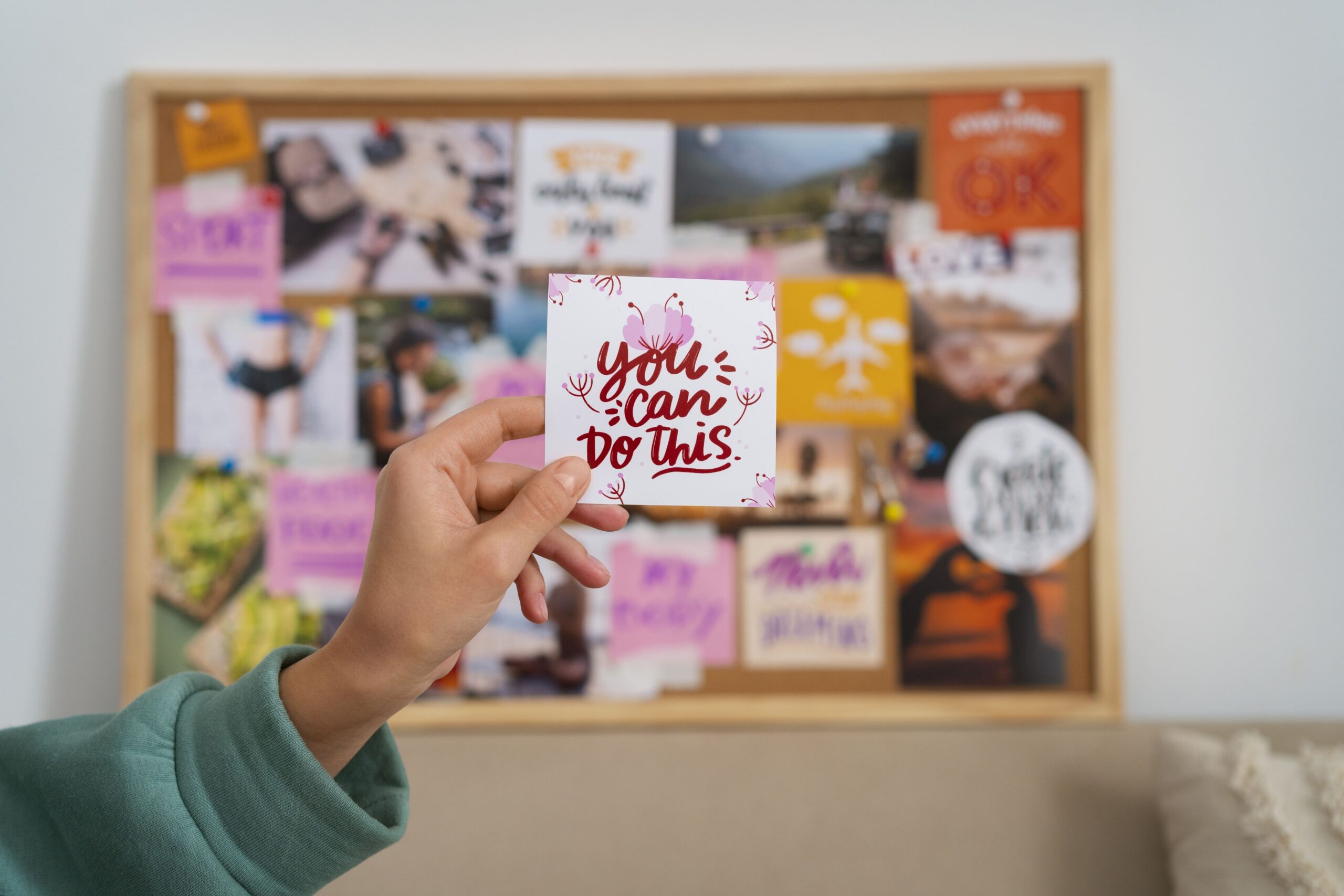
To make this even easier, I created a small, simple physical vision board and hung it on my bedroom wall. I put images of my goals and dreams on that board. Looking at those pictures every day gives my brain a clear target and forces it to focus on what really matters instead of spiraling into endless worries.
When your mind is actively focused on your real goals, it stays motivated and it simply doesn’t have the room or energy left to overthink. This is why it’s so effective in reducing overthinking. Making a vision board for yourself is actually much easier than you might think. You can check out this vision board supplies list and also find relevant images online or in printed magazines.
Now, whenever my eyes wander around my room while I’m starting to overthink, they land on my goals instead. It acts like a giant reset button for my mind. Instead of picturing chaos, my brain automatically switches back to picturing my future.
Step 4: Practice the 5-4-3-2-1 Grounding Technique
When overthinking takes over, your mind is essentially traveling in time. You are either trapped in the past regretting something you said, or trapped in the future worrying about something that hasn’t happened yet.
The quickest way to pull your mind back into the present moment is through your five senses.
Whenever I feel a spiral of overthinking coming on, I use a simple sensory tool called the 5-4-3-2-1 method. I pause wherever I am and quietly identify:
5 things I can see: (A blue mug, sunlight on the floor, a houseplant, a pen, my shoes)
4 things I can physically feel: (My feet pressed against the floor, my cozy sweater, the cool breeze, the texture of my desk)
3 things I can hear: (Birds outside, the quiet hum of the fridge, traffic in the distance)
2 things I can smell: (Fresh coffee, my hand lotion)
1 thing I can taste: (Mint toothpaste, a sip of water)
By forcing your brain to focus on real physical sensations right now, you interrupt the mental loop. Your body relaxes because it realizes there is no emergency happening in this exact second.
Step 5: Schedule a Dedicated “Worry Window”
Telling an overthinker to “just stop worrying” is completely useless—if it were that easy, we would have done it already! Instead of trying to banish worries entirely, try giving them a specific time slot.
I created a 15-minute “Worry Window” every afternoon at 4:00 PM.
If a scary, overthinking thought pops into my head at 10:00 AM, I don’t argue with it. Instead, I tell myself: “That is a valid thought, but it is not 4:00 PM yet. I will worry about that during my worry window.”
When 4:00 PM rolls around, I sit down with my notebook and let myself worry completely uncensored for 15 minutes.
Two amazing things happen when you do this:
It frees up your entire morning because you aren’t trying to solve problems out of schedule.
By the time 4:00 PM arrives, most of those morning worries don’t even feel important anymore, and you end up moving on with your day.
You Deserve a Quiet Mind
Overthinking is just a bad habit your brain learned to try and protect you. But you don’t have to stay stuck in your own head forever.
You don’t need to change your entire life overnight. Just pick one small tool from this list today:
Write down your messy thoughts on paper.
Take one tiny five-minute step.
Focus on positive visual cues.
Ground your mind using your five senses.
Set aside a specific 15-minute “worry window.”
Your peace of mind isn’t something you have to travel far away to find. It is right here, waiting for you to slow down, take a deep breath, and close a few of those extra mental tabs.

markmunroe
Latest posts by markmunroe (see all)
- Five Benefits of Taking a Digital Detox One Day Per Week - August 17, 2026
- Top Interior Home Door Trends for 2026 - July 31, 2026