
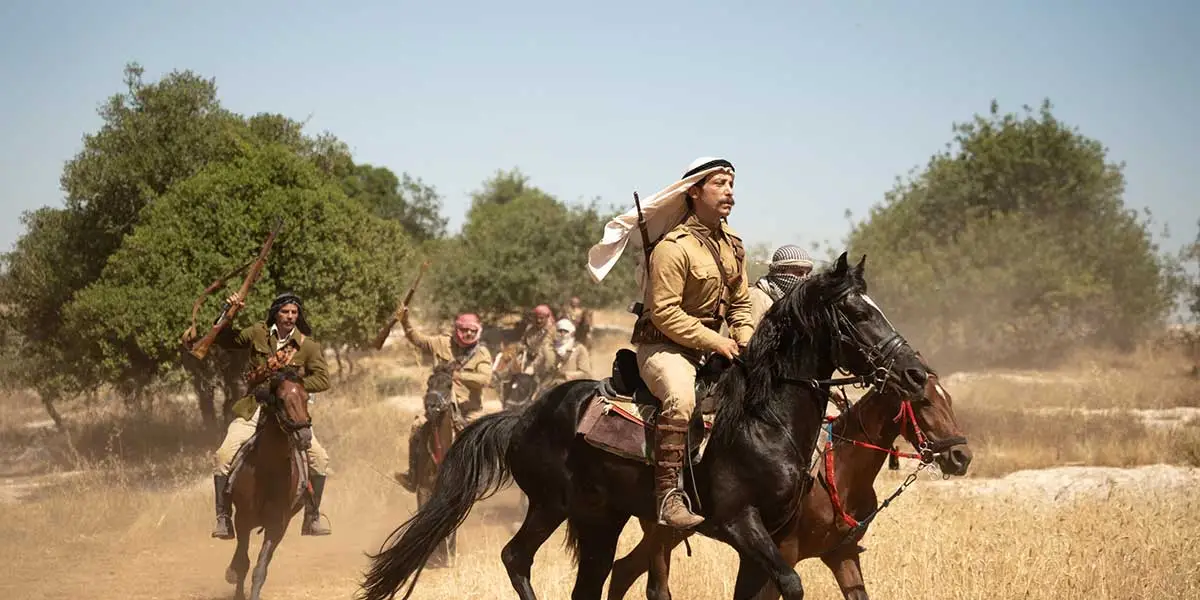
Palestine 36 premiered as a Gala Presentation at the Toronto International Film Festival and is now the official Palestinian submission to the Academy Awards. Set in 1936, director Annemarie Jacir’s fourth feature looks at the year that led into the Arab Revolt, when Palestinians were still trying to negotiate their future without realizing they were being written out of it. The result is a period drama that feels both vividly historical and eerily current, as the world once again turns its gaze toward the Middle East at another turning point in its history.
Jacir, known for emotionally resonant films rooted in the lived realities of Palestinians, builds Palestine 36 around intersections instead of individual heroes. Rather than focusing on a single character thread, she creates a mosaic of a society that is waking up to its own erasure. She exposes how class became its own kind of colonial weapon in British Mandate Palestine. The middle and upper classes believed their education and proximity to power would protect them, while abandoning the peasants who were struggling to hold their land as Britain abused their administrative power to usurp inheritance laws and dispossess Palestinians.
Palestine 36 opens with fragments—family, tradition, politics—that all seem unconnected, until they gradually assemble into something that is both communal and intimately personal. Yousef (Karim Daoud Anaya), the bridge between the city and country, is drawn into circles of influence he can’t control. Through him, we meet a cast of landowners, mothers, priests, and journalists, each confronted with the slow violence of occupation. In Jerusalem, Yousef works as a driver for Amir, a respected publisher and political operative, and his wife, Khuloud (Yasmine Al Massri), a journalist who relies on news from Thomas (Billy Howle), a sympathetic British informant and secretary to a British governor (played by Jeremy Irons). The governor who claims regret for Britain’s harsh policies, but offers little support to the inhabitants of Palestine.
Meanwhile, in the village of Al Basma, Yousef’s life has a different rhythm. Here, generations of Palestinian families who have lived and worked on this land for centuries now watch the looming threat of land redistribution creep closer to their village. Rebab (Yafa Bakri), a young widow, faces the human cost of expropriation as she is forced to watch her world change as the small community is tormented by a villainous British military captain (Robert Aramayo). Through it all, Rebab tries to shield her daughter, Afra (Wardi Eilabouni), and teach her that continuity is possible, even if the landscape may look different. Also, Afra’s friendship with Kareem (Ward Helou), the son of Father Bolous (Jalal Altawil), the village’s Orthodox Christian priest, is another small anchor.
Within these threads, each character is pushed to the brink–forced to make choices that will determine their fate and the fate of those they love, as they struggle to preserve their humanity within their homeland.
It’s through each character’s individual journey that Jacir maps the true cost of Palestine’s illegitimate “development” into a nation by the British. That’s the beauty and sorrow of Jacir’s film—it lays out what’s been stolen: not just land, but ancestry and authorship. At the same time, she elevates the ordinariness of resistance—showing how for each character it can innately choose rebellion when it’s clear it is prerequisite for survival. This is what makes Palestine 36 feel like a sigh—exhaling over a century of ghosts. These are stories that lived in the body of a nation, documented and denied in equal measure, until Jacir turned them into a film that finally speaks in the language of the living.
The film is undeniably beautiful, anchored by remarkable performances and rare archival footage that give the drama historical weight. Together, these elements create a tender narrative that captures the complexity and diversity of Palestine.Jacir vividly recreates Jerusalem at a crossroads, a city alive with cultures after the fall of the Ottoman Empire, reshaped by the arrival of European Jews escaping the Nazis, and strained under British colonial rule. The film also foregrounds the deep roots of Christianity in the region and highlights the pivotal role of Palestinian women, who, during this crucial year turned necessity into activism—organizing protests, leading relief efforts, and breaking into journalism.
Jacir’s film is a rare historical drama that focuses on the documented experiences of Palestinians powerless in the distribution of colonial power. Nearly a century later, the same struggle continues; whose histories survive, and whose voices are systemically silenced. Watching Palestine 36 feels like witnessing history broadcasted on the screen. The film is as much a story of Palestine as it is about confronting how systems built on power decide who is seen, who is erased and who has their story told.
Highly recommend. Bring tissues.
https://www.watermelonpictures.com/films/palestine-36

Marie Nicola
Latest posts by Marie Nicola (see all)
- Where Hot Pot Meets Grill in Toronto’s Chinatown - December 7, 2025
- Raoul Peck’s Documentary Orwell: 2+2=5 is Furious and Exhausting - December 3, 2025